


- Content

The process of international relocation and legalization within a European jurisdiction requires applicants to systematically complete administrative, immigration, and tax-related steps. Under the financial and immigration laws of the Republic of Cyprus, citizens of the Republic of Kazakhstan are classified as residents of third countries. Moving to the island is not limited to physical relocation but also involves establishing personal and corporate infrastructure under the supervision of government agencies. Successful integration depends on choosing the correct legal basis, ensuring the transparency of financial records, and meeting regulatory deadlines for submitting applications.
Preparing for the Move
The initial stage of relocation determines the structure of the documents to be gathered and the legal framework for future life on the island. Planning errors at this stage lead to the denial of residency cards and financial losses.
Defining Objectives
The immigration strategy must fully align with the applicant’s actual plans. The republic’s legislation does not allow for a free change of business activity without altering the applicant’s underlying immigration status. Business owners, remote workers, and passive investors undergo verification procedures under different regulations. Relocating without the intention of integrating into the local labor market requires demonstrating stable external capital. The intention to engage in commercial activities obligates the entrepreneur to register a legal entity and apply for immigration quotas. Attempting to use passive status to engage in covert employment is considered a violation of the law.
Choosing a Residence Permit Program
The Migration Department of the Republic of Cyprus administers temporary and permanent immigration permits for third-country nationals. The choice of program depends on the nature of the applicant’s income and willingness to invest. Under current law, the following official pathways are available to citizens of Kazakhstan:
- a temporary residence permit for financially independent individuals (Visitor TRC), issued without the right to engage in any employment within the country;
- a special program for digital nomads (Digital Nomad Visa Scheme), designed for remote employees of foreign companies;
- application for a residence and work permit through verified international companies with foreign interests;
- a permanent immigration permit for investors based on Regulation 6.2 of the General Rules on Foreigners and Immigration.
Each category has its own residency requirements. Visitor card holders lose their status if they are absent from the republic for more than 90 consecutive days, whereas investors need only visit the island once every two years.
Financial Planning
The calculation of a relocation budget must be based on fixed government standards approved by the relevant agencies. Financial institutions and immigration services verify not only the availability of funds in accounts but also the tax history of capital in Kazakhstan. Financial planning involves preparing documentation in three mandatory areas:
- confirmation of a guaranteed annual or monthly income from abroad that meets the limits of the selected immigration program;
- opening a deposit account at a Cypriot bank to secure the mandatory bank guarantee to cover potential deportation costs;
- proof of the transfer of the entire amount of investment capital exclusively from the applicant’s accounts outside Cyprus.
The amount of the deportation guarantee for citizens of Kazakhstan is set at 850 euros per family member, including minor children. These funds are frozen in a special account secured by a bank letter of guarantee.

Housing Search
Having a verified place of residence is a requirement common to all immigration and tax pathways. Government agencies do not accept the use of formal addresses or P.O. boxes.
Purchasing Real Estate
The purchase of new-construction residential properties grants access to an expedited program for obtaining permanent residency under Regulation 6.2. The minimum investment threshold is 300,000 euros, excluding value-added tax. The law permits the purchase of up to two residential properties from a single developer. The full amount must be paid in full prior to submitting the documents to the Department of Migration. The funds are transferred from the investor’s overseas accounts to the seller’s account at an accredited Cypriot financial institution. Transfers of funds through third-party jurisdictions or payment systems are not recognized by government agencies for the purpose of verifying immigration capital.
Long-Term Lease
To apply for a temporary residence permit as a visitor or digital nomad, a real estate lease agreement with a term of at least 12 months is required. The living quarters must meet health and safety standards and be suitable for the size of the household. The lease agreement must undergo a mandatory physical certification process by an authorized village head or certifying officer. The document must be registered and stamped by the Cyprus Tax Department. Having a legal address is also critical for meeting bank compliance requirements. Financial institutions use it to verify the client’s connection to the island and to calculate their tax profile.
Choosing a Region
The distribution of business activity and social infrastructure determines the specific characteristics of the republic’s districts. District immigration units of the police have varying workloads, which directly affects the processing times for cases. Limassol is the main business and technology hub, where the offices of international companies with foreign interests are concentrated. Nicosia serves as both the administrative capital and the main hub for government agencies, including the central office of the Tax Department. Paphos and Larnaca are characterized by a more relaxed pace of life and less congestion at immigration offices, which helps reduce the waiting period for residence cards.
Documents Required for Relocation
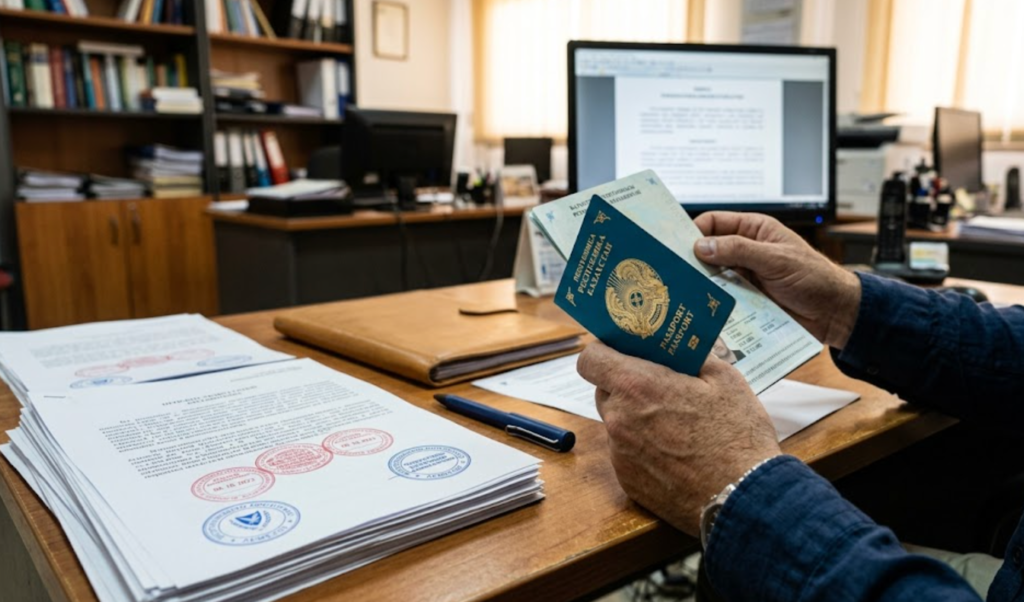
The process of compiling an immigration dossier begins in Kazakhstan. All official documents issued by government agencies of the Republic of Kazakhstan must be apostilled and translated into English or Greek by a certified translator directly in Cyprus.
Passport
Identification is the first step in the verification process conducted by immigration authorities and banks. The Ministry of Foreign Affairs of the Republic of Cyprus includes Kazakhstan on its official list of countries whose citizens are required to obtain an entry visa using a regular passport. A short-term Category C national visa allows you to stay on the island for up to 90 days within any 180-day period and can be used to prepare documents and rent housing. Your passport must have at least two blank pages. Its validity must extend at least 6 months beyond the requested stay; however, for long-term programs, it is recommended to have a passport valid for at least 2 years.
Financial Documents
Demonstrating financial solvency requires more than simply providing statements showing the balance of funds. The client is required to disclose the historical chain of capital formation. The financial dossier is structured according to the chosen migration category:
- Applicants under the visitor program must prove a guaranteed foreign income of at least 24,000 euros per year for the principal applicant, with a 20% allowance for a spouse and a 15% allowance for each child;
- remote professionals under the Digital Nomad program must provide contracts and statements showing a net monthly income of at least 3,500 euros after taxes in Kazakhstan;
- Investors must provide official declarations from the Kazakhstani tax authorities on Forms 250.00 and 270.00, confirming the payment of capital taxes in the amount of 50,000 euros per year.
Simple bank statements without tax documents explaining the source of the capital are rejected by compliance departments.
Health Insurance
Every foreign national applying for a residence card is required to have an insurance policy covering health-related risks. Without proof of insurance, the Department of Migration will reject the application during the document submission stage. For temporary residence permits, the standard requirement is to obtain a private insurance policy covering outpatient and inpatient treatment in Cyprus, as well as the cost of repatriating remains. The average market cost of such a policy is 175 euros per year per person. When applying for a temporary residence permit for the first time, applicants undergo a medical examination in Cyprus, including blood tests for HIV, syphilis, and hepatitis B and C, as well as a chest X-ray to rule out tuberculosis.
Family Relocation
The Republic’s legislation allows the principal applicant to include close relatives in the immigration application. The legal status of family members is derivative; therefore, the revocation or denial of renewal of the principal applicant’s documents automatically terminates the permits of dependent family members.
Spouses
Spouses receive resident cards with the same validity period. When relocating under the Visitor or Digital Nomad programs, the law imposes a total ban on dependent spouses engaging in any economic activity in Cyprus. Spouses are not permitted to take employment with local companies or register their own sole proprietorships without changing the entire family’s basic immigration status. An exception is made for family members of top executives at companies with foreign interests, who are granted automatic, regulated access to the labor market. An apostilled marriage certificate must be provided to confirm the family relationship.
Children
Minor children are entitled to long-term residence on the island and integration into the local community. Including children in the application requires increasing the main applicant’s financial support by 15% under temporary programs or by 10,000 euros per year under the investment track. A background check and the submission of a criminal record check from the Ministry of Internal Affairs of the Republic of Kazakhstan are required for all applicants over the age of 16. Apostilled birth certificates must be provided to confirm parental rights. When moving with one parent, the notarized consent of the other parent, certified with an apostille stamp, is required.

Education in Cyprus
The public education system guarantees access to secondary education for all residents of the island. The Ministry of Education, Sport, and Youth of Cyprus establishes a rule under which all children physically present in the republic are entitled to enrollment in public elementary schools, regardless of citizenship or whether their parents have official resident status. Instruction in public schools is conducted in Greek. To enroll, you must provide the child’s identification documents, proof of a local address, and a vaccination record. Documents regarding previous education from schools in Kazakhstan must be apostilled in advance through the electronic services of the eGov.kz government portal. Private English-language schools operate under their own regulations and require the payment of annual tuition fees.
Adjustment After Relocation
The final stage of relocation involves setting up household and tax infrastructure. Failure to meet the deadlines for registration leads to administrative fines and the risk of retroactive revocation of residency status.
Banking Services
Interacting with institutions regulated by the Central Bank of Cyprus requires compliance with rigorous procedures. Holding a residence permit changes a client’s status from non-resident to foreign resident, simplifying transactions. Financial institutions provide residents with a full range of services:
- opening checking and savings accounts in euros without the strict limits imposed on tourists;
- unrestricted international transfers for rent, utilities, and children’s education;
- access to online banking and cards from international payment systems such as Visa and Mastercard.
The bank regularly monitors account activity. If the actual account activity does not match the profile provided during registration, the compliance department will request further clarification.

Taxes
An individual’s tax residency does not arise automatically upon obtaining a residence permit. The Tax Department determines tax obligations based on two tests: the 183-day rule and the 60-day rule. After obtaining a residence permit, a resident planning to transfer their tax residency must register with the Tax Department within 60 days and obtain a taxpayer identification number through the Tax For All electronic system.
The Republic has a tax reform program in place (Tax Reform 2026). All personal income tax calculations and the application of deductions are carried out through a personal tax calculator in the Tax For All system, which takes the new deduction rules into account. The base corporate tax rate for companies is 15% of net profit. Possession of a Cyprus Tax Resident Certificate allows one to take advantage of the Non-Domicile regime, which exempts expats from paying the Special Defense Contribution on dividends and interest for up to 17 years.
At the same time, ownership of a European business imposes an obligation on a citizen of Kazakhstan to declare controlled foreign companies. The Tax Code of the Republic of Kazakhstan requires residents of the Republic of Kazakhstan to notify the authorities of any ownership interests in foreign entities and to pay a 10% tax on undistributed profits. Complete withdrawal from Kazakhstan’s tax jurisdiction requires a detailed audit of ties to the home country.
Health Care
Access to the National Health System (GESY) is strictly regulated and is not automatically granted to all holders of temporary residence cards. Third-country nationals who have official employee status in Cyprus, holders of permanent residence permits with no expiration date, and their family members may register in the system and use the beneficiary portal. Registration is carried out through a specialized electronic portal after contributions to the Social Insurance Service have been recorded. Individuals residing under the visitor or digital nomad programs do not make contributions based on local employment; therefore, they use private health insurance policies to cover risks throughout their entire stay on the island.
When planning for a long-term stay on the island, investors must take into account that Cypriot law allows for applying for a passport through naturalization after prolonged residence; however, the laws of the Republic of Kazakhstan strictly prohibit dual citizenship. If a citizen acquires a foreign passport, they are required to notify the internal affairs authorities of the Republic of Kazakhstan within 30 calendar days and surrender their Kazakhstani documents, under penalty of substantial fines and the forced revocation of Kazakhstani citizenship.

Elina Almanova
Advocate